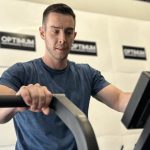
This post will focus on a recent competition one of our athletes (Matt Brady) competed at as part of the CrossFit Games season. The purpose of this article is to elaborate on some of the training he undertook with his Coach (Scott Gillis) in preparation. A novel element of preparation for this event was the fact that it would be held in California in early summer. Being Matt lives in Calgary, the element of heat was going to be an important component to train for.
Below, you will find a commentary from Matt’s coach as well as an interview I did with Matt. The commentary and the interview contain a lot of practical information. At the bottom of the article, you will find some recommended reading to go along with this subject.
From Scott Gillis, Matt’s Coach:
Matt recently competed at the Northern California Classic, which is held in Sacramento, California. Compared to Calgary, AB, Sacramento is incredibly hot, so we had to do some heat training in an attempt to adapt Matt’s ability to dissipate the effects of the heat without actually being in that environment.
Essentially what we were trying to do was: 1) improve temperature regulation 2) reduce heart rate in those hot environments, and 3) to achieve 1, 2, with a lower RPE than he otherwise would have experienced. Generally, it takes anywhere from 7-14 days to fully acclimatize to the heat, in the specific environment you are going to be exposed to.
Because Matt wasn’t going to be in the actual environment much in advance of his competition we had to replicate that environment here and we did so by adding as many layers as we deemed appropriate and safe. For example, sweat pants, long sleeve shirts (even sweatshirts), and hats in the already 20+ degree weather. We did this for about two and a half weeks in advance of his competition and then did some training in Sacramento leading into his event to accomplish this.
Although I thought the heat training went quite well, there were some things I was a bit unsure about. For instance: we didn’t know if there would be a running event, and if so, how long it would be. Based on past events, there was the potential for a long run, so we had to plan for that. However, running for extended periods of time with layers of clothes on in the already hot temperatures (by Calgary standards anyhow) does come with some safety concerns. Although, Matt is a proficient runner who can run long distances, we had to slowly ramp up that volume of running to ensure we weren’t stressing his body too much. The other consideration was to run earlier in the day on hot days, or, if running the afternoon to adjust the amount of clothing we were wearing to ensure we were doing it safely.
Matt felt really good all weekend and his results prove that, so I feel like we executed it as close to perfectly as we could have. If we had more time, we would have utilized it and ramped a bit slower, but his competition schedule just did not allow for that.
Ideally, you would train in the specific environment to acclimatize, but that simply isn’t feasible for most people, so this method of heat training certainly does work – at least in my experience. The big caveat is to continue to check in with your athlete(s) and keep a close eye on their performance. You will sacrifice a bit of performance because of the heat aspect, but if done correctly, their prior training will be sufficient to carry them through this short period of “acclimation” and that is going to have a bigger effect on a competition weekend than two more weeks of non-specific heat training, in my opinion.
During the interview with Matt, we allude an email I sent him and a few others in 2024 prior to the CrossFit Semifinals that was to be held in Carson, California. Unfortunately, Matt was unable to compete in that event, but the others were.
Here is the content of that email:
I figured I would send you all an email regarding this topic and you and your coach can discuss what you would like to do with it.
Recently, I have been looking through some heat acclamation research to try to give some ideas to you all going to Carson to compete. To my understanding, the event will be outside, in the sun. If I am incorrect, and they have changed it to some indoor facility, then you can pretty much ignore this email.
I won’t go into too much detail but I’ll just provide you a basic insight of what the purpose of following these protocols would be.
When you engage in intense activity you will experience an increasing body temperature (which is why you sweat). This happens regardless of the temperature of the environment you are in. But it becomes more important when you are engaged in intense activity, while also in a hot and humid environment (i.e. Carson, California). The reason being is that an increased core body temperature causes some large changes with regards to blood flow and with regards to your own ability to engage in activity. Suffice to say, it makes performing to your capabilities both physiologically and psychologically more difficult.
The following are some protocols to try to minimize/negate the negative effects that result from exposure to heat during intense activity.
1 – the first point to make is that research suggests the range of acclimation to heat can be anywhere from 7 to 14 days if a continual effort is put forth (i.e. improving your own tolerance to heat, like having actual physiological adaptations). I would recommend you start working towards these things immediately, in some form or another. Again, talk with your coach and work it out as much gonna be best for you.
2 – the next point is the recommendation to have a high core body temperature for an extended period of time. At least 38.5 C for up to 100 minutes or more at a time, but just do your best. If you were going to actually assess your core body temperature, the easiest one would be to measure via your armpit but you would probably have to see 39°C on the measurement. Again, just do your best.
3 – the best way to get better at performing in the environment you’re going to be performing in is to actually go to the location and exercise. So, go to Carson as early as it’s feasible for you prior to semis and get use to their climate.
4 – the simplest strategy you can implement while here in Calgary is to overdress for some training sessions. Meaning, instead of wearing minimal clothing because you feel warm, wear too much clothing and perform the same training, knowing you are going to feel HOT. This will keep you warmer for longer and help with the process of psychologically getting used to being warm. As well, it will increase the time in which your core body temperature is raised as getting rid of heat will be limited.
5 – another thing to do while here in Calgary would be to train in the sun when possible. Especially when it’s warm outside. You have to manage how much time you spend in the sun, so as to not drain yourself for the following day. But, this is a readily available option for you. You can also overdress for this as well.
6 – another option that I think would be relevant for you all would be to combine a training session that is challenging followed by sitting in a sauna or sitting in a hot tub. The purpose of this is to raise core body temperature from the training session itself, followed by sitting in a warm environment afterwards so as to not allow the core body temperature to come down. To me, the easiest way to do this would probably be to do a treadmill running session at the YMCA and follow it up by going in the sauna for 30 to 60 minutes afterwards. Again, you have to balance the stress of this session with the recovery needed. You may want to plan to do this prior to a rest day the first time you try it. As it may leave you feeling very tired.
7 – some basic recommendations for while you are in Carson is to wear reflective or light clothing. For example, don’t wear anything black or try to limit the amount of black clothing you wear while in the sun and competing.
8 – Bring a large brimmed hat minimize sun exposure during your time there.
9 – prior to and following events the recommended way to reduce perceived heat (assuming you are feeling hot), meaning to make yourself feel better, would be to cool your face, your neck, your head, your armpit, etc. This could only be 30 seconds in total, and it would help you prior to an event.
10 – as you adapt to the heat, you will likely begin to sweat earlier into a training session, or at least that’s what research suggests will happen. So, even if you don’t feel thirsty, or you don’t feel like you need to hydrate, you probably do.
Training for Hot Environments2025-07-062025-07-07https://optimumperformancecalgary.com/wp-content/uploads/2019/02/opt-old-logo.pngOptimum Performance Traininghttps://optimumperformancecalgary.com/wp-content/uploads/2023/07/img_2682.jpg200px200px